Riddles Test - 500 Brain Games
Idle BootsTrivia
4.34.01K Reviews
- Version
- 27
- Installs
- 1.00M
- Age Rating
- Everyone
Screenshots
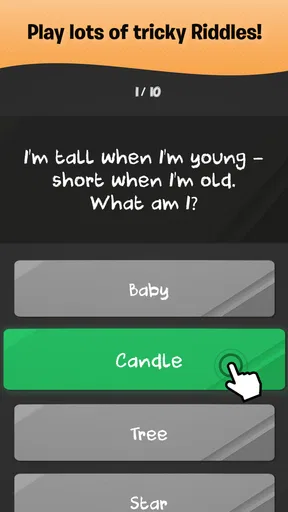
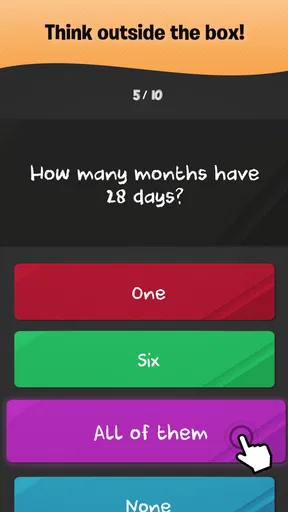
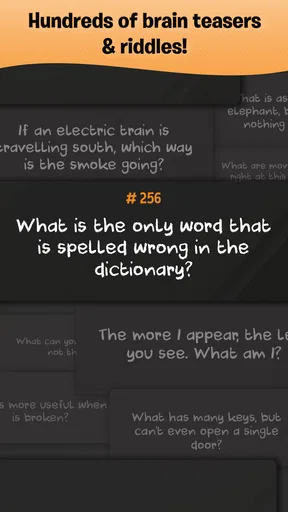
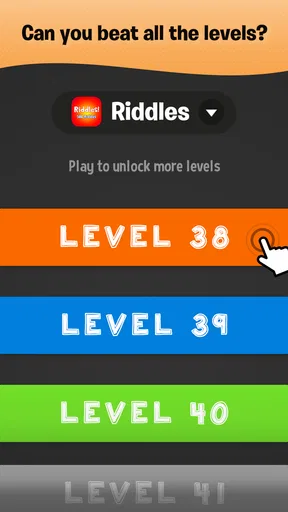
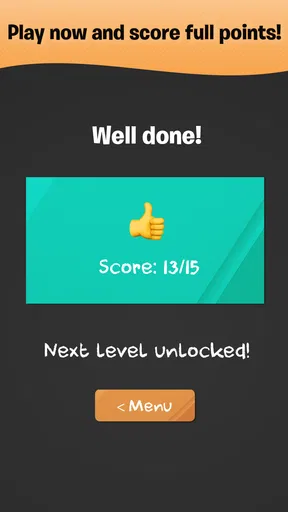
Our Review of Riddles Test - 500 Brain Games
 Analysis by Appyee
I opened Riddles Test - 500 Brain Games expecting a quick collection of questions, and that is exactly where its appeal begins. This is a free trivia game from Idle Boots that focuses on riddles, logic puzzles, tricky questions, and simple IQ-style challenges rather than fast reflexes or complicated controls. I could start solving almost immediately, which makes it an easy choice when I want something to do for a few spare minutes.
The game suits a particular kind of player: someone who enjoys stopping to examine the wording of a question and testing an idea before committing to an answer. It is not a traditional quiz about geography, history, or entertainment, so I would not install it expecting a broad knowledge test. Its challenge comes more from interpretation and lateral thinking. A question may look obvious at first, then force me to reconsider what it is really asking.
Idle Boots presents the title as an offline riddle experience, which is especially useful for short sessions away from a reliable connection. I can imagine keeping it available for a commute, a waiting room, or a quiet break when I want a mental distraction without entering a large multiplayer game. The store summary also places brain teasers and IQ tests at the center, and that description matches the way the game feels in use.
What the first session feels like
The first meaningful success is simple: read a puzzle carefully, choose an answer, and learn from the result. That sounds basic, but it is important for a casual game. There is no long tutorial to understand before the central activity makes sense. The main loop is immediately recognizable, so a first-time player can concentrate on the wording instead of learning a complex interface.
I recommend treating the opening questions as a warm-up rather than as a test of intelligence. Some riddles reward common sense, while others depend on noticing a small assumption hidden in the sentence. If an answer seems too easy, I pause and ask myself whether I am reading the question literally or filling in details that were never actually stated. That habit is more useful here than trying to answer as quickly as possible.
A realistic everyday use is a five-minute break between tasks. I might solve one puzzle while waiting for a kettle to boil, then stop without feeling that I have abandoned a long match. The short-session nature is one of the strongest reasons to try it. It does not demand the attention that a full strategy game or a lengthy trivia round usually requires.
The game is also suitable for sharing a puzzle with another person. A tricky question can become a small conversation: one person suggests the obvious answer, another looks for a wordplay angle, and the reveal gives both players something to discuss. I would use it this way with family or friends who enjoy verbal puzzles, although people who dislike deliberately misleading questions may find that style irritating rather than entertaining.
Getting started without overthinking the setup
The practical entry point is uncomplicated. The game is free, carries an Everyone content rating, and runs on Android versions beginning with 5.1. That makes it accessible on a wide range of devices, including older phones that may not be ideal for visually demanding games. Its current version is 27, so a new player is not starting with an early experimental release.
After installing it, I would first check how the question and answer controls behave rather than rushing through several screens. The most useful early adjustment is mental, not technical: expect the game to challenge assumptions. If a riddle mentions an object, a person, or an action, I try not to add background information that the text never gives me. This prevents many wrong answers before they happen.
Because the experience is designed around riddles rather than a large visual world, the phone itself is not the main attraction. A smaller screen should still be comfortable for reading, but I would avoid playing while distracted by notifications or conversation. The wording is the content, so missing one short phrase can change the entire puzzle. In that sense, the game rewards attention more than hardware.
For a first session, I suggest solving a small handful of questions slowly. Do not use speed as the measure of progress. Instead, notice which kinds of puzzles cause trouble. If literal wording is your weakness, underline the key condition mentally. If you tend to choose the first plausible answer, force yourself to imagine one alternative before tapping. This turns the game into a small exercise in reasoning instead of a sequence of guesses.
The first successful answer and what it teaches
When I solve a riddle correctly, the satisfaction usually comes from seeing the trick in retrospect. The answer often feels fair once the important detail has been noticed, even if I missed it initially. That makes a wrong answer useful rather than purely frustrating. I can compare my first interpretation with the intended one and gradually become better at spotting the structure of these questions.
My best advice for a new player is to separate reading from answering. First, read the complete question. Next, identify the exact thing being asked. Finally, consider whether the wording contains a limitation, an unusual comparison, or a familiar phrase used in an unexpected way. This three-step pause is a concrete way to improve performance without needing hints, notes, or outside material.
Another useful approach is to say the riddle aloud. Hearing the sentence can reveal a double meaning that is easy to overlook when reading quickly. I would not do this for every puzzle, but it helps when the wording feels awkward or when two possible answers seem equally reasonable. The game becomes more enjoyable when I treat the language itself as part of the puzzle design.
I also avoid assuming that a difficult question must require advanced knowledge. The challenge is often in the framing, not in remembering a fact. That distinction makes the game approachable for casual players and younger users, while still giving experienced puzzle fans a reason to slow down. Since the age rating is Everyone, it can work as a light family activity, provided everyone is comfortable with the occasional trick question.
Where new players can become confused
The biggest source of confusion is the difference between a knowledge quiz and a riddle game. In a conventional trivia app, the best strategy is often to recall information quickly. Here, that instinct can lead me in the wrong direction. A confident answer based on outside knowledge may be less useful than a careful answer based only on the exact wording in front of me.
Another friction point is the feeling that a puzzle is unfair when the intended interpretation is not immediately visible. I have found it better to reread the sentence before deciding that the question is poorly written. Sometimes the issue is my assumption; sometimes the wording simply does not match the way I naturally think. Either way, the pause helps me distinguish a genuine logic challenge from a careless guess.
Players should also be prepared for repetition in the general style of challenge. The game’s identity depends on riddles, so anyone wanting constantly changing mechanics, animated battles, or a deep progression system may lose interest. Its variety comes from the questions and their twists, not from switching between entirely different game modes. That is a reasonable trade-off, but it is worth understanding before downloading.
I would not recommend relying on random tapping. Guessing can occasionally produce a success, but it teaches nothing about the puzzle’s logic. A better routine is to explain your proposed answer to yourself in one sentence. If you cannot explain why it fits the wording, you probably have not finished thinking. This small discipline makes the game more rewarding and reduces the sense that outcomes are arbitrary.
How it compares with familiar alternatives
Compared with a standard trivia app, this game is less about measuring what I already know and more about testing how I interpret a prompt. That makes it a better fit when I want a compact brain teaser rather than a broad quiz covering many subjects. Someone preparing for a general knowledge contest would probably get more value from a subject-based trivia app, while someone who enjoys riddles may find this more engaging.
It also differs from crossword puzzles and word searches. Those alternatives usually provide a visible grid and a gradual process of filling spaces. Here, the main work happens before answering: I analyze the sentence, challenge my assumptions, and look for the intended twist. If you prefer a quiet puzzle with a physical structure to work through, a crossword may feel more satisfying. If you enjoy verbal surprises, this format is more direct.
Against brain-training apps with timed exercises and performance charts, the game feels more relaxed. I do not approach each question as a scientific measurement of my abilities. I approach it as a short reasoning challenge. That is a strength for casual use, but a weakness for anyone seeking detailed progress tracking or a carefully structured training program. The experience is about solving individual riddles, not building a formal cognitive routine.
It is also a different proposition from multiplayer quiz games. There is no need to wait for opponents or compare an answer with a live group before moving on. That makes it more convenient when I am offline or alone. On the other hand, players who enjoy competition, social rankings, and real-time pressure may find the solitary format too quiet. The right choice depends on whether the goal is reflection or rivalry.
Who will enjoy it most
I think the strongest audience is made up of casual puzzle fans who like wordplay and can accept being misdirected for a moment. It is particularly convenient for people who want an offline game that can be opened and closed during small gaps in the day. The free price removes the need to make a large commitment, and the Everyone rating makes it easier to consider for shared household use.
It can also work well for parents or teachers looking for a few conversation starters, although I would preview questions before presenting them to very young children. The age label is broad, while individual riddles can still vary in difficulty and tone. Asking a child to explain an answer may be more valuable than simply telling them whether they are right, because the explanation encourages careful reading.
I would be more cautious about recommending it to players who need clear rules, predictable logic, or a strong sense of advancement. A riddle can feel subjective when its trick depends on language, and not every puzzle will appeal equally to every reader. If you prefer measurable scores, timed rounds, or a visible campaign, a more structured quiz or puzzle title may be a better match.
Useful habits for getting more from the game
One practical habit is to keep a mental record of the types of mistakes you make. If you repeatedly overlook a word such as “only,” “before,” or “ever,” you have identified a reading pattern to watch. If you instead jump to familiar answers, give yourself a deliberate pause. This turns individual failures into a personal method for improving, which is more useful than simply moving on.
A second habit is to play with different levels of attention. During a short break, I might answer a straightforward riddle quickly. When I have more time, I revisit a difficult one and write down two interpretations before choosing. The same game can therefore serve as light entertainment or as a more deliberate reasoning exercise, depending on how much effort I bring to it.
A third tip is to use discussion as a tool rather than as a way to obtain the answer immediately. If another person sees the solution, ask what phrase led them there. Comparing interpretations exposes the assumption that caused the mistake. This is especially effective with children, because it encourages them to justify an answer instead of treating the game as a simple right-or-wrong test.
Finally, I would stop playing when the wording starts to feel irritating. Riddle games depend on curiosity, and forcing myself through puzzles after that curiosity has disappeared makes the experience worse. The short-session format makes it easy to return later with a clearer mind. I do not need to finish a long match, so taking a break is part of using the game well.
My recommendation after spending time with it
Riddles Test - 500 Brain Games has a clear purpose and stays close to it. Idle Boots offers a free trivia game built around brain teasers and tricky reasoning rather than graphics, competition, or specialist knowledge. Its offline focus makes it practical, and the simple format means a first-time player can reach the central challenge without a long learning curve.
The game has attracted over a million installs, with an average rating of 4.3 from around forty thousand ratings and roughly four thousand written reviews. Those figures suggest that its straightforward format has found a substantial audience, but they should not replace personal taste. The important question is whether you enjoy puzzles that make you question the first answer that comes to mind.
I would recommend trying it if you want a compact companion for waiting, commuting, or taking a break from more demanding games. Start slowly, read every word, and treat wrong answers as clues about your own assumptions. I would skip it if you want multiplayer competition, rich visual progression, or a factual quiz covering many academic subjects. For everyone else, it is an approachable way to turn a few empty minutes into a small exercise in attention and lateral thinking.
Verdict
Strengths of Riddles Test - 500 Brain Games
- 500 puzzles provide plenty of content for regular play.
- Short challenges are convenient for quick breaks or commutes.
- The variety of riddles helps prevent the gameplay from feeling repetitive.
- Useful for exercising logic, attention, and lateral-thinking skills.
- Simple controls make it accessible to most ages and experience levels.
Limitations of Riddles Test - 500 Brain Games
- Some riddles may feel subjective or have answers that are hard to guess.
- Difficulty can vary sharply between consecutive puzzles.
- Hints or solutions may reduce the challenge for experienced players.
- Repeated puzzle styles may become less engaging over long sessions.
- Offline availability and progress syncing may vary by device or version.
Similar Picks in This Category
View All
Millionaire 2026 Quiz & Trivia
Quiz & Trivia Games by Submarine Apps4.5

Brain Test 2: Tricky Stories
Unico Studio4.7

Trivia Crack: Brain Quiz Games
etermax4.4

QuizzLand. Quiz & Trivia game
Quiz & Trivia Games by Mno Go Apps4.8

Brain Test: Tricky Puzzles
Unico Studio4.7

Logo Quiz
bubble quiz games4.5
Frequently Asked Questions
What is Riddles Test - 500 Brain Games?
Riddles Test - 500 Brain Games is a puzzle and trivia-style app built around a large collection of riddles. It challenges you to read clues carefully, identify hidden meanings, and select or enter the most logical answer. The difficulty varies from simple wordplay to more demanding questions, making it suitable for short sessions or longer brain-training breaks.
Is Riddles Test - 500 Brain Games suitable for all ages?
The app is generally accessible to teenagers and adults, especially anyone who enjoys word puzzles, logic questions, and lateral-thinking challenges. However, some riddles may depend on vocabulary, cultural references, or abstract reasoning, so younger children could need help with certain levels. Parents should also review the app’s store rating and content details before allowing children to use it.
Does the game require an internet connection?
Many riddle apps can be played offline once their content is available on the device, but connection requirements may depend on the version, advertisements, updates, and platform. Before starting a long offline session, open several levels while connected and check whether the app continues working in airplane mode. Internet access may still be needed for downloads, purchases, analytics, or ad-supported features.
Are there hints, skips, or ways to get help when an answer is difficult?
Riddles Test - 500 Brain Games is designed to make you think, so some questions can be intentionally tricky or use unexpected wording. Depending on the current version, assistance may include hints, revealing letters, skipping a puzzle, or checking an answer after repeated attempts. These options may be limited or connected to ads or in-app purchases, so review the on-screen rules before using them.
Is Riddles Test - 500 Brain Games free to download and play?
The app may be available as a free download, but the overall experience can include advertising, optional purchases, or restrictions on hints and additional content. The exact pricing and features can change between Android and iOS versions and after updates. Check the official store listing for the latest information, including permissions, subscription details, in-app purchase costs, and whether removing ads requires payment.
Play our best games!


